Walter Seymour’s polished and accurate prose is full of sharp and witty remarks that make him a perfect example of the travelling gentleman of the Victorian era, a sort of real life Phileas Fogg whose hand does not tremble when writing down impressions on the ways, manners, morals and South American politics –little has changed since–.
Born on the 9th December, 1838, at Kinwarton, in Warwickshire, Walter was one of the five sons of Richard Seymour,a Canon of Worcester in charge of the Rectory.
There must have been something inspiringly adventurous in the Seymour home atmosphere, as two of the five sons travelled to South America, a most exotic destiny at the time.
Richard Jr. attempted a country esquire life in the middle of the savage Pampa land, and back in England wrote"
Pioneering in the Pampas" an interesting racconto of his efforts.
Walter, more mundane, wrapped up his own adventures in
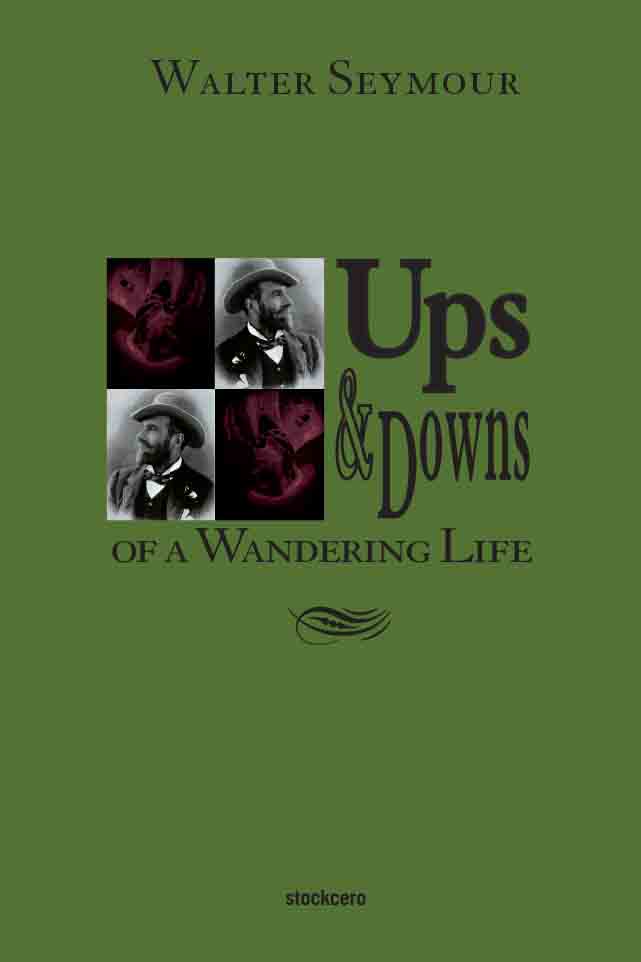
“Ups and Downs of a Wandering Life”, a most suitable title for the amusing biography of the unpredictable outcome of strict Victorian upbringing.
Study at Christ Church, a seat in the office of the Surveyor of the Navy
–now called the Comptroller–, in Whitehall, transferral to the office of the Secretary of the Admiralty and later on junior accountant of the House of Commons, proved to be just transient stages to be resigned in order to embark in adventure.
Italy and
Palestine, and then
Argentine
–where his brother Richard was attempting to set as
“estanciero” surrounded by the indian’s threat– were his first escapades.
Back in England, a short stint at The Flying Squadron –no airplanes in 1870’s but frigates and several of the new
“composite” vessels, a sort of compromise between a steamer and a sailing ship–, and having his
“soul wearied to death of inspecting factories in Birmingham”, Walter’s wandering urges lead to an hilarious stay at
Paraguay where
“a complication turned
up - one of those natural epidemics in South America, a revolution”, defining that all business predictably enough ended up in lawsuits.
Venezuela,
Portugal,
Spain, mingle with socialite stints at
Dinard (France),escapades to
Italy and
Egipt and even a long stay at the
US rubbing elbows at
Bal Harbor with none less than
Mr Pulitzer himself, who when once at London
“wanted some Englishman to come with him…”
“...As to what are called their morals, I believe that
the ways of society change little and slowly. There always have been faster and slower sets, prim and loose ones, frumps and frolickers...”
“...I have lived to see divorce become common, almost customary; one meets few families in which there has not been one. In old days it was the luxury of the great and the rich; now it is almost cheap, and it is generally very nasty as well...”
"...My experiences of life in South American republics have shown me that a republican government means a scramble for power, and for the money that clings to that power. In the Argentine tranquillity and turmoil - called revolution - are alternative states of government..."
“... Like boys who all want a ride on one donkey, they shout, “Get off. You have ridden him long enough; it’s my turn”, and if the rider won’t get off he is chucked off, and the most active at the moment gets up...”
“...The population of the Southern Republics was drawn from countries almost despotically governed, so anarchy and despotism were the natural alternate outcome. The United States Republic so far does not acknowledge the Divine right of revolution. They had a serious attempt at it, but since it failed they have not repeated it....”
“...And now, having made some few remarks and reflections on what I have learnt from life, I leave my character and my credit in the hands of my reader, advising him to have as few personal habits as possible, and as few small daily necessities; it is the upsetting of these which makes half the misery of life; the big upsettings are rare…”





Customer reviews functionality will be available soon.