
Aves sin nido
By Clorinda Matto de Turner: A Foundational Indigenista Novel
 Add Print Copy to Cart
US$ 25.50
Purchase Online Access
US$ 9.99 (1-year access, creditable)
Add Print Copy to Cart
US$ 25.50
Purchase Online Access
US$ 9.99 (1-year access, creditable)
🎁 24 hours of Free Reading
(No Credit Card Needed)
Professor's Resource
📥 Download Free Teaching KitIncludes critical analysis, class topics & quiz bank.
SCAN TO INTERACT/BUY WITH YOUR SMARTPHONE
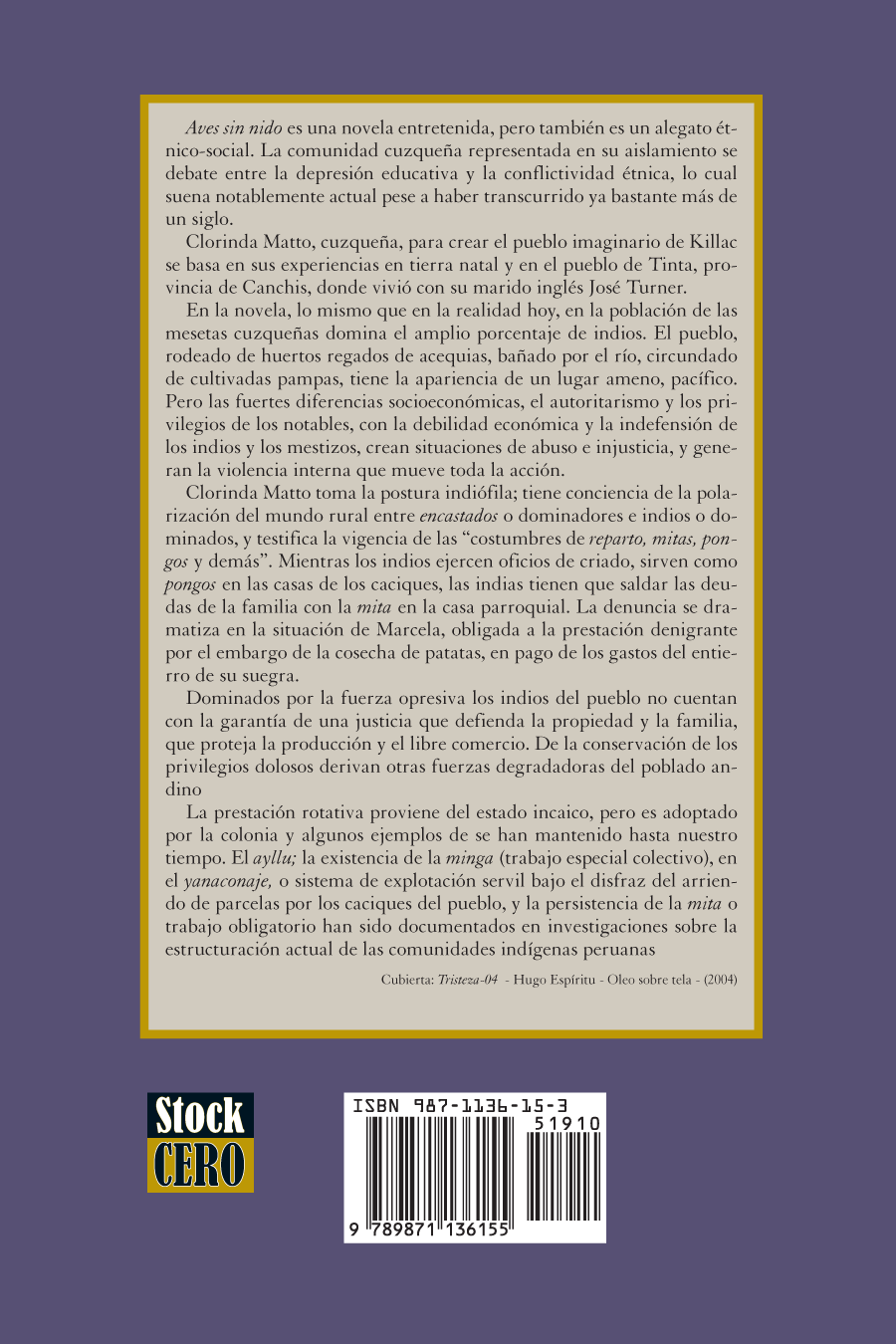
Aves sin nido is not only an engaging novel but also a powerful ethno-social indictment. Written by a woman in Peru in 1889, its value is profoundly twofold. The isolated Cusco community, depicted as grappling with educational underdevelopment and ethnic conflict, resonates remarkably with contemporary issues despite more than a century having passed.
Clorinda Matto, a native of Cusco, based the imaginary town of Killac on her experiences in her homeland and in Tinta, Canchis province. In the novel, as in reality, the Indigenous population constitutes a large percentage of the inhabitants of the Andean highlands. The stark socio-economic disparities, authoritarianism, and privileges of the "notables," coupled with the economic vulnerability and defenselessness of the Indigenous and mestizo populations, create situations of abuse and injustice that drive the narrative.
The Marín couple, Don Fernando and Lucía, representing an educated, urban middle-class intelligentsia, act as the author's mouthpiece. They champion an ideological project rooted in a reformed Catholic morality and a cultural model influenced by positivist theories and liberal ideas. Matto de Turner adopts a clear indigenista stance, acutely aware of the rural world's polarization between dominators and the dominated.
The novel vividly testifies to the prevalence of "customs of repartos, mitas, pongos, and others." While Indigenous men serve as household servants (pongos) for local chiefs, Indigenous women are forced to settle family debts through mita (forced labor) at the parish house. This denunciation is powerfully dramatized in Marcela's plight, compelled to degrading service due to the embargo of her potato harvest to cover her mother-in-law's funeral expenses.
Dominated by oppressive forces, the Indigenous people of the town lack the guarantee of justice. The preservation of detrimental privileges fuels other degrading forces in the Andean village. Matto de Turner writes:
The novel further includes a powerful indictment of undernourishment as a degrading factor, highlighting how physical deprivation contributes to social subjugation. The marginalization and exploitation are dramatically underscored in the forced servitude and the unjust execution of the wool trade. The rotational service system, originating in the Inca Empire and adopted by the Spanish colony, with some examples persisting to this day, underscores the enduring historical roots of these injustices.
ISBN: 978-987-1136-15-5
Pages: 196
Author: Clorinda Matto de Turner
Stockcero Edition Advantage: Features an unparalleled apparatus of 332 lexical and contextual notes, making complex historical and cultural references accessible to modern students.
Retail Price (Print): US$ 25.50
Online Reading: US$ 9.99 (1-year access, fully creditable towards print purchase)
Evaluation Copy (Professors): US$ 16.58
This title is part of these collections:
Realismo Social e Indigenismo (5 Books)
Foundational voices of Latin American social struggle. Includes Azuela, Icaza and Vallejo.
Retail Price: US$ 154.10
Bundle Price: US$ 115.58 (Save US$ 38.53 - 25% OFF!)
VIEW SOCIAL REALISM BUNDLEPerú Profundo: The Indigenista and Feminist Voice (4 Books)
A curated collection of Clorinda Matto de Turner's pioneering works. Essential for gender studies and Andean literature.
Retail Price: US$ 126.50
Bundle Price: US$ 94.88 (Save US$ 31.62 - 25% OFF!)
VIEW PERÚ PROFUNDO BUNDLE

|
The Stockcero Guarantee
SpanishBookPress Editions. |