
Autonosuya
By Francisco Fontanilles y Quintanilla
 Add Print Copy to Cart
$29.20
Add Online Access
$9.99
Add Print Copy to Cart
$29.20
Add Online Access
$9.99
🎁 24 hours of Free Reading
(No Credit Card Needed)
Professor's Resource
📥 Download Free Teaching KitIncludes critical analysis, class topics & quiz bank.
SCAN TO INTERACT/BUY WITH YOUR SMARTPHONE
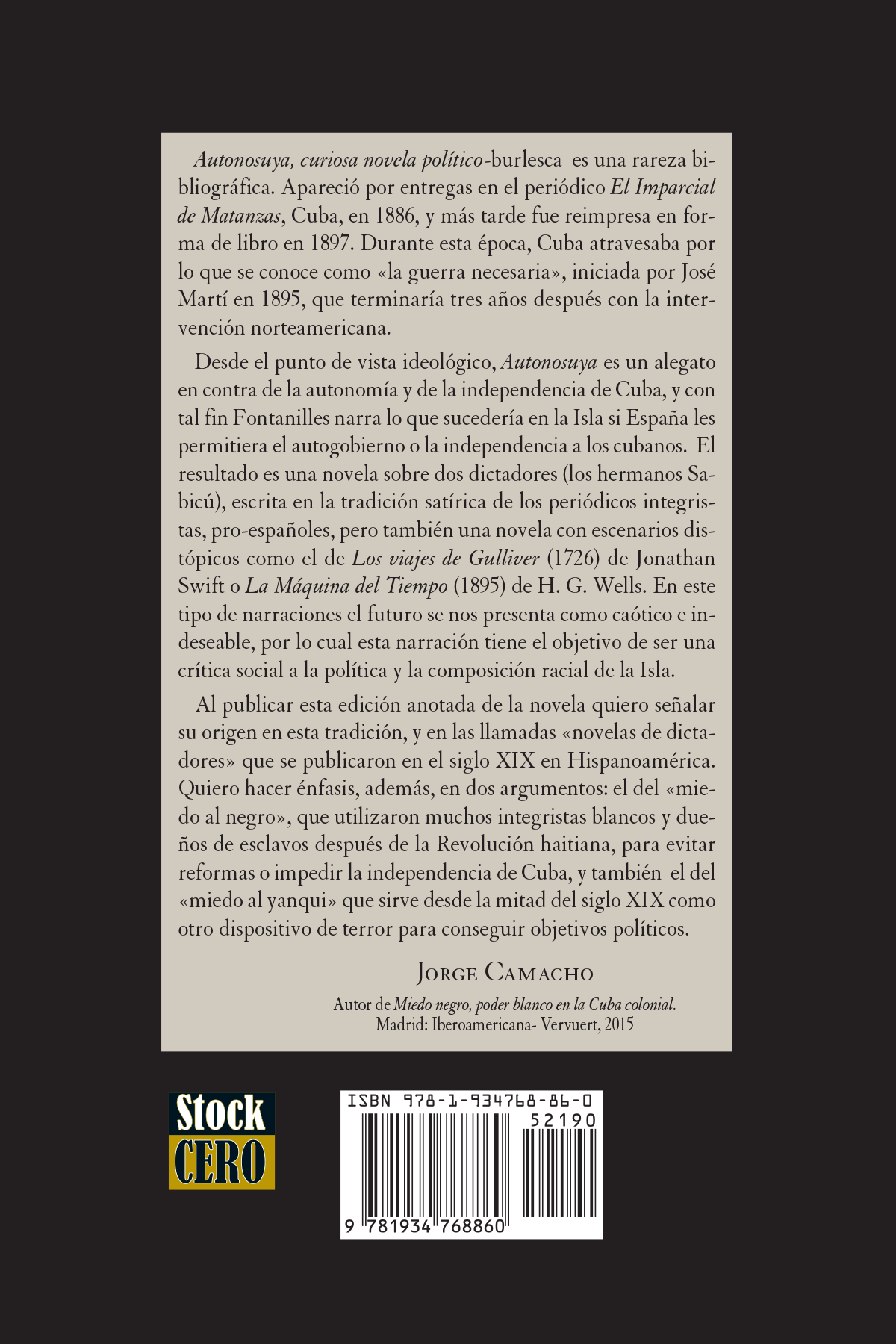
Published in 1886 in El Imparcial de Matanzas and later reissued as a novel in 1897, Autonosuya is a fascinating political-burlesque novel by Francisco Fontanilles y Quintanilla (1833-1887). This novel serves as a powerful piece of colonial propaganda, designed to dissuade readers from supporting Cuban autonomy or independence by portraying a dystopian vision of the island under self-governance.
Fontanilles, a staunch conservative who edited pro-integrationist newspapers in Cuba, paints a bleak picture of a future where autonomy leads to chaos, “African demagoguery,” and economic ruin. The narrative unfolds as protagonist Pantaleón Visiones returns to Havana to find a country ruled by the "semi-savage" mulatto dictators, the Sabicú brothers, who institute brutal tyrannies, execute political opponents, and dismantle any vestiges of European civilization.
The novel leverages the prevalent “fear of the Black man” (“miedo al negro”) to argue against independence, suggesting that it would inevitably lead to a “race war” and the “barbarism” of non-white rule. Fontanilles invokes historical examples like the Haitian Revolution and draws parallels with Latin American caudillos, but projects these fears onto Cuban autonomists and separatists, portraying them as irresponsible, naive, or ultimately detrimental to Cuba's stability.
Autonosuya is a didactic and ideological text, utilizing satire and exaggerated scenarios to reinforce the integrationist thesis: that Cuba must remain "white and Spanish." It highlights the anxieties of the colonial elite regarding the growing non-white population and the potential for a reversal of social hierarchies. The novel's provocative ending, where Cuba is eventually taken over by the United States and populated by “southern Blacks,” underscores the deeply racialized fears driving the colonial discourse.
This critical edition aims to rescue an overlooked narrative that vividly recreates the political and racial tensions in late 19th-century Cuba. It offers invaluable insights into the rhetoric used against independence and autonomy, and illuminates the complex interplay of power, race, and identity in the Hispanic Caribbean. Edited by Jorge Camacho, this edition provides a crucial lens for understanding the colonial imagination and the construction of “the other” during a pivotal period in Cuban history.
ISBN: 978-1-934768-86-0
Pages: 128 (In Spanish)
Editor: Jorge Camacho
Price (Print): $29.20
Price (Evaluation): $18.98
Price (Online): $9.99
Explore the Afro-Hispanic & Caribbean Collection
This edition is part of our comprehensive collection on the rich heritage of the African diaspora in the Hispanic world.
View the Full CollectionThe Afro-Hispanic & Caribbean Collection
Purchase all five foundational texts for a comprehensive study of the Black experience in the Hispanic world.
Retail Price: $173.50
Bundle Price: $130.13 (Save $43.37!)
BUY THE 5-BOOK BUNDLE & SAVE

|
The Stockcero Guarantee
SpanishBookPress Editions. |